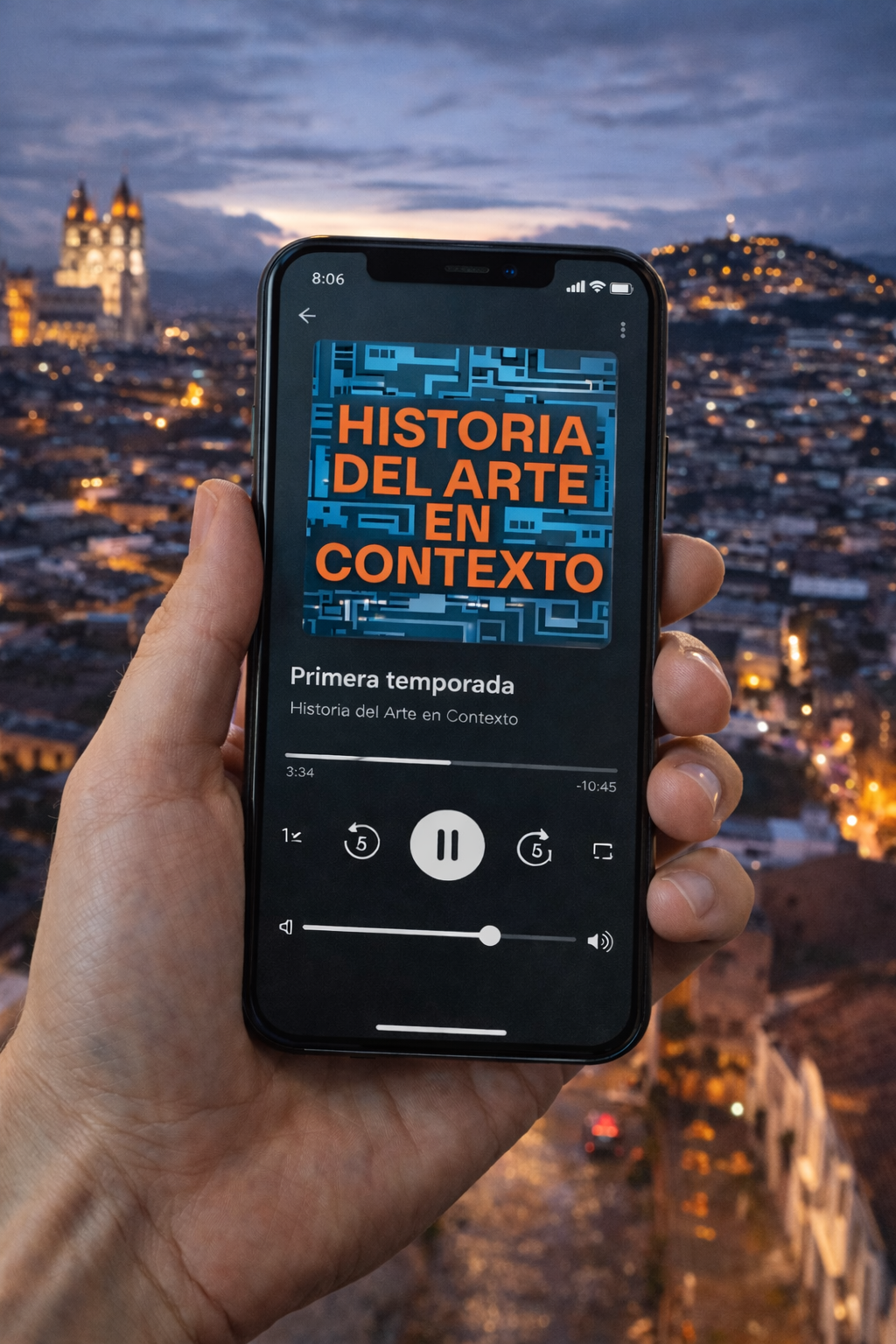
Historia del Arte en Contexto (2025 - 2026), es un podcast que explora el arte latinoamericano desde Quito, Ecuador. Abordando temas desde el siglo XIX hasta hoy. Conducido por Gonzalo Vargas M., este podcast aborda los vínculos entre arte, política e identidad, recorriendo temas como el muralismo, el indigenismo, la antropofagia y las vanguardias. Una mirada crítica y situada sobre la modernidad y la contemporaneidad desde el Sur.
History of Art in Context (2025 - 2026) is a podcast that explores Latin American art from Quito, Ecuador, covering topics from the 19th century to the present. Hosted by Gonzalo Vargas M., the series examines the connections between art, politics, and identity, moving through themes such as muralism, indigenismo, anthropophagy, and the avant-gardes. It offers a critical, situated perspective on modernity and contemporaneity from the Global South.
Temporada 1 /Season 1 (2025)
Este episodio explora cómo las vanguardias latinoamericanas del siglo XX redefinieron la relación entre arte, política y modernidad. A través de revistas como Amauta, Martín Fierro y Proa, artistas y escritores como Mariátegui y Torres-García construyeron una red continental de pensamiento. Un recorrido por las ideas, manifiestos y visualidades que reinventaron la modernidad desde el Sur.
This episode explores how 20th-century Latin American avant-gardes redefined the relationship between art, politics, and modernity. Through magazines such as Amauta, Martín Fierro, and Proa, artists and writers like Mariátegui and Torres-García built a continental network of ideas. It traces the concepts, manifestos, and visual cultures that reinvented modernity from the Global South.
Un recorrido por las tensiones entre arte y poder en el Cono Sur y los Andes: Tucumán Arde y el Itinerario del 68 en Argentina; la Escena de Avanzada y el CADA en Chile; y, en Ecuador, la Revolución Cultural de 1966, la Bienal de Quito y el programa del Grupo VAN. Un mapa de cómo el arte hizo de la calle, el cuerpo y el lenguaje un territorio de resistencia.
A journey through the tensions between art and power in the Southern Cone and the Andes: Tucumán Arde and Argentina’s Itinerary of ’68; Chile’s Escena de Avanzada and CADA; and, in Ecuador, the 1966 Cultural Revolution, the Quito Biennial, and the Grupo VAN program. A map of how art turned the street, the body, and language into a territory of resistance.
En este episodio de Historia del Arte en Contexto, se explora cómo el arte conceptual transformó la práctica artística en pensamiento y anticipó el surgimiento del capitalismo cognitivo. A través de las obras de Sol LeWitt, Joseph Kosuth, Helio Oiticica y Mauricio Bueno, el episodio recorre las mutaciones del trabajo artístico —de la materia a la idea, del objeto al lenguaje, del cuerpo a la luz— para comprender los conceptualismos del sur y el papel del arte como forma de conocimiento en la era inmaterial.
In this episode of History of Art in Context, we explore how conceptual art transformed artistic practice into thought and anticipated the rise of cognitive capitalism. Through the works of Sol LeWitt, Joseph Kosuth, Hélio Oiticica, and Mauricio Bueno, the episode traces shifts in artistic labor—from matter to idea, from object to language, from body to light—to understand conceptualisms from the Global South and the role of art as a form of knowledge in the immaterial era.
En este episodio de Historia del Arte en Contexto, exploramos el paso del Universalismo Constructivo de Joaquín Torres-García y el arte concreto argentino hacia la abstracción moderna en el Ecuador.
La figura de Araceli Gilbert emerge como un punto de inflexión: pionera del constructivismo, mujer moderna en un entorno patriarcal, y artista que llevó la geometría y el color hacia una síntesis
profundamente americana.Desde Montevideo, Buenos Aires y París, hasta Quito y Guayaquil, este episodio traza una constelación de viajes, rupturas y retornos que dieron forma a una modernidad del sur.
In this episode of History of Art in Context, we explore the transition from Joaquín Torres-García’s Universal Constructivism and Argentine Concrete Art to modern abstraction in Ecuador.
Araceli Gilbert emerges as a turning point: a pioneer of Constructivism, a modern woman in a patriarchal environment, and an artist who carried geometry and color toward a deeply American synthesis.
From Montevideo, Buenos Aires, and Paris to Quito and Guayaquil, this episode traces a constellation of journeys, ruptures, and returns that shaped a modernity from the Global South.
En este episodio de Historia del Arte en Contexto recorremos la historia de los manifiestos que acompañaron la irrupción de las vanguardias en América Latina. Desde la antropofagia brasileña y el universalismo constructivo rioplatense, pasando por el concretismo, el neoconcretismo y los hartos mexicanos, hasta el VAN y Arte en la Calle en Ecuador, seguimos cómo artistas, poetas y colectivos usaron la escritura como arma estética y política. Más que programas estilísticos, estos textos funcionan como gestos de emancipación simbólica: maneras de decir “aquí estamos, pensamos distinto, imaginamos otro mundo” para el arte y para el continente.
In this episode of History of Art in Context, we trace the history of the manifestos that accompanied the emergence of the avant-gardes in Latin America. From Brazilian Anthropophagy and Río de la Plata Universal Constructivism, through Concretism, Neo-Concretism, and Mexico’s Los Hartos, to VAN and Arte en la Calle in Ecuador, we follow how artists, poets, and collectives used writing as an aesthetic and political weapon. More than stylistic programs, these texts operate as gestures of symbolic emancipation—ways of saying: “we are here, we think differently, we imagine another world,” for art and for the continent.
En este episodio de Historia del Arte en Contexto miramos el lado menos visible de las vanguardias: la crítica de arte. Entre 1920 y 1970, las batallas por el arte moderno latinoamericano se dieron también en periódicos, revistas, catálogos, radio y televisión. A través de figuras como Marta Traba en Colombia, Mário Pedrosa y Ferreira Gullar en Brasil, Jorge Romero Brest y Aldo Pellegrini en Argentina, seguimos cómo se tradujeron las vanguardias para el público, se construyeron cánones, se negoció con París y Nueva York y se tensó la relación entre arte y política. Un recorrido por las palabras que acompañaron, defendieron y discutieron el arte moderno en el continente.
In this episode of History of Art in Context, we look at the less visible side of the avant-gardes: art criticism. Between 1920 and 1970, the battles over Latin American modern art also played out in newspapers, magazines, catalogs, radio, and television. Through figures such as Marta Traba in Colombia, Mário Pedrosa and Ferreira Gullar in Brazil, and Jorge Romero Brest and Aldo Pellegrini in Argentina, we follow how the avant-gardes were translated for broader audiences, how canons were built, how negotiations unfolded with Paris and New York, and how the relationship between art and politics was continually tested. A journey through the words that accompanied, defended, and debated modern art across the continent.
En este episodio de Historia del Arte en Contexto revisamos qué fue el simbolismo y por qué es importante para entender la modernidad artística en América Latina. Partimos de la Europa de fin de siglo XIX, con sus crisis del positivismo, sus visiones, sus sueños y sus figuras cargadas de espiritualidad y deseo, para seguir las rutas por las que estas imágenes y sensibilidades llegan al continente.
Desde ahí nos centramos en el caso ecuatoriano. Por un lado, analizamos la obra de Víctor Mideros y su “misticismo patriótico”, donde la pintura religiosa se convierte en escenario para pensar la nación y sus conflictos. Por otro, nos acercamos al universo íntimo y autobiográfico de Eduardo Solá Franco, sus diarios ilustrados y su teatro de los afectos, donde el símbolo se vuelve máscara, deseo y archivo personal.
In this episode of History of Art in Context, we revisit what Symbolism was and why it matters for understanding artistic modernity in Latin America. We begin in late 19th-century Europe—marked by crises of positivism, visions and dreams, and figures charged with spirituality and desire—and follow the routes through which these images and sensibilities reached the continent.
From there, we focus on the Ecuadorian case. On one hand, we examine the work of Víctor Mideros and his “patriotic mysticism,” where religious painting becomes a stage for thinking through the nation and its conflicts. On the other, we move into the intimate, autobiographical universe of Eduardo Solá Franco—his illustrated diaries and his theater of affects—where the symbol becomes mask, desire, and a personal archive.
En este episodio de Historia del Arte en Contexto revisito la exposición “La Avanzada Ancestralista 1956–1980” presentada en el MAAC de Guayaquil, para pensar el ancestralismo como uno de los grandes umbrales de la modernidad artística ecuatoriana. A partir del proyecto Umbrales del arte en el Ecuador. Una mirada a los procesos de nuestra modernidad estética, dirigido por Lupe Álvarez, y de las curadurías de Rodolfo Kronfle Chambers —en especial Ecos del tiempo. Revisitando el ancestralismo en el arte moderno del Ecuador y la propia muestra de la avanzada ancestralista—, exploramos cómo artistas como Tábara, Maldonado, Villacís o Viteri cruzaron abstracción moderna y memorias prehispánicas. Más que “arte folclórico”, el ancestralismo aparece aquí como una vanguardia compleja, atravesada por debates sobre identidad, Estado-nación, colonialidad y las tensiones entre orgullo indígena y lenguajes internacionales de la modernidad.
In this episode of History of Art in Context, I revisit the exhibition La Avanzada Ancestralista 1956–1980, presented at the MAAC in Guayaquil, to consider ancestralism as one of the major thresholds of Ecuadorian artistic modernity. Drawing on the project Umbrales del arte en el Ecuador: Una mirada a los procesos de nuestra modernidad estética, directed by Lupe Álvarez, and on Rodolfo Kronfle Chambers’s curatorial work—especially Ecos del tiempo: Revisitando el ancestralismo en el arte moderno del Ecuador and the Avanzada Ancestralista exhibition itself—we explore how artists such as Tábara, Maldonado, Villacís, and Viteri brought modern abstraction into dialogue with pre-Hispanic memory. Rather than “folk art,” ancestralism appears here as a complex avant-garde, shaped by debates on identity, the nation-state, coloniality, and the tensions between Indigenous pride and the international languages of modernism.
En este episodio de Historia del Arte en Contexto, recorro elrealismo social en América Latina como una decisión ética y política, más que como un estilo. Viajo por tres estaciones. En México, el muralismo aparece como arte público, pedagogía e intento de reorganizar el relato nacional tras la Revolución. En Argentina, Antonio Berni convierte el realismo en un laboratorio material y narrativo, donde tema, forma y resto histórico se tensionan. En Ecuador, el indigenismo pictórico abre una modernidad situada, pero también instala un régimen de representación que a veces habla por otros y consolida un canon. Para complejizarlo, recupero la presencia de mujeres artistas y desplazo el foco hacia la gráfica con Galo Galecio, donde lo social circula como imagen múltipley también incorpora representaciones de lo afrodescendiente. El episodio cierra con una pregunta: cuando el arte dice “pueblo”, ¿quién habla y desde dónde?
In this episode of History of Art in Context, I trace social realism in Latin America as an ethical and political choice rather than a style. The journey unfolds through three key stations. In Mexico, muralism emerges as public art, pedagogy, and an attempt to reorganize the national narrative after the Revolution. In Argentina, Antonio Berni turns realism into a material and narrative laboratory, where subject matter, form, and historical residue remain in tension. In Ecuador, pictorial indigenismo opens a situated modernity, yet it also establishes a regime of representation that can speak for others and consolidate a canon. To complicate this story, I foreground the presence of women artists and shift the focus toward printmaking through Galo Galecio, where the social circulates as a multiplied image and also includes representations of Afro-descendant communities. The episode closes with a question: when art says “the people,” who is speaking—and from where?
En este episodio, que cierra la temporada de Historia del Arte en Contexto, nos detenemos en una pregunta que Ecuador tardó décadas en procesar: ¿cuándo y cómo la fotografía deja de ser solo prueba, documento o registro, y se reconoce como arte?
A partir de la idea de la fotografía como huella y como construcción de memoria, recorremos las tensiones institucionales que mantuvieron a la fotografía en los márgenes del sistema artístico, dominado por la pintura, el objeto único y las jerarquías de la “alta cultura”. Con Umbrales del arte en el Ecuador como punto de apoyo, entendemos la fotografía como un patrimonio simbólico decisivo para la modernidad estética ecuatoriana.
El eje del episodio es Hugo Cifuentes (Otavalo, 1923–2000), figura bisagra entre la vanguardia pictórica de los sesenta y la consolidación del ensayo fotográfico en los ochenta. Su obra aparece como una ética de la mirada: lo cotidiano, el trabajo, la fiesta y la religiosidad popular no como postal, sino como experiencia compleja. Nos detenemos en Huañurca (Premio Casa de las Américas, 1983), leído a través del texto de Pedro Meyer, para pensar la confianza, la cercanía y el riesgo de fotografiar la muerte sin convertirla en espectáculo.
Cerramos con una idea simple: en Ecuador la fotografía no entró al arte por decreto, entró por insistencia, obra, redes y pedagogías. Y dejamos abierta la siguiente temporada: los años noventa, cuando la fotografía se articula con nuevas acciones, actores y lenguajes contemporáneos.
In this episode—closing the season of History of Art in Context—we pause on a question Ecuador took decades to process: when and how does photography stop being seen only as proof, document, or record, and come to be recognized as art?
Starting from the idea of photography as both trace and a construction of memory, we follow the institutional tensions that kept the medium at the margins of an art system dominated by painting, the unique object, and the hierarchies of “high culture.” With Umbrales del arte en el Ecuador as a point of reference, we understand photography as a decisive symbolic heritage for Ecuadorian aesthetic modernity.
At the center of the episode is Hugo Cifuentes (Otavalo, 1923–2000), a pivotal figure between the pictorial avant-garde of the 1960s and the consolidation of the photographic essay in the 1980s. His work becomes an ethics of seeing: everyday life, labor, celebration, and popular religiosity not as postcard imagery, but as complex experience. We linger on Huañurca (Casa de las Américas Prize, 1983), read through Pedro Meyer’s text, to think about trust, proximity, and the risk of photographing death without turning it into spectacle.
We close with a simple idea: in Ecuador, photography did not enter art by decree—it entered through insistence, work, networks, and pedagogies. And we open the door to the next season: the 1990s, when photography becomes entangled with new actions, actors, and contemporary languages
Temporada 2 /Season 2 (2026)
En este episodio viajamos al Ecuador de los años ochenta, unadécada marcada por crisis políticas, retorno a la democracia y una modernidad pictórica que empieza a desbordarse. Revisamos cómo Quito y Guayaquil viven esta transición: La Galería y la Galería Madeleine Hollaender, el trabajo deartistas como Marcelo Aguirre, Pilar Flores y Hugo Cifuentes, y las irrupciones de La Artefactoría en la calle y en la Bienal de Cuenca. Sumamos la figura migrante y disidente de George Febres para pensar el lugar del humor, la diáspora y el sida en estos relatos. Un recorrido por los años en que el arte ecuatoriano comienza a dejar de ser solo pintura de caballete.
In this episode, we travel to Ecuador in the 1980s—a decade marked by political crisis, the return to democracy, and a pictorial modernity beginning to overflow its own limits. We revisit how Quito and Guayaquil moved through this transition: La Galería and the Madeleine Hollaender Gallery, the work of artists such as Marcelo Aguirre, Pilar Flores, and Hugo Cifuentes, and La Artefactoría’s interventions in the street and at the Cuenca Biennial. We also bring in the migrant and dissident figure of George Febres to consider the place of humor, diaspora, and AIDS within these narratives. A journey through the years when Ecuadorian art began to move beyond easel painting.
Cildo Meireles (Brasil, 1948) es una de las figuras clave del artecontemporáneo latinoamericano. En este episodio exploramos cómo su obra deja de “representar” lo político para operar directamente sobre los sistemas que organizan la vida: el consumo, el dinero, la información y la historia. Desde la serie Inserciones en circuitos ideológicos,donde interviene botellas de Coca-Cola y billetes que vuelven a circular en lo cotidiano, hasta instalaciones monumentales como Bab (una torre de radios que emiten simultáneamente) y Misión/Misiones (Cómo construir catedrales) (un dispositivo material sobre la evangelización, la extracción y la violencia colonial), Meireles convierte la experiencia en un campo de tensión.
A partir de Boris Groys, entendemos la instalación como una forma de poder: un territorio temporal donde el artista organiza recorridos, intensidades y condiciones de percepción. Meireles no denuncia desde afuera: intercepta desde adentro. Y al hacerlo nos deja una pregunta urgente: ¿qué significa comunicarse, habitar y pensar críticamente en un mundo saturado de circuitos, ruido e imágenes?
Cildo Meireles (Brazil, 1948) is one of the key figures in contemporary Latin American art. In this episode, we explore how his work moves beyond “representing” politics to operate directly on the systems that organize life: consumption, money, information, and history. From the series Insertions into Ideological Circuits—where he intervenes Coca-Cola bottles and banknotes that re-enter everyday circulation—to monumental installations such as Babel (a tower of radios broadcasting simultaneously) and Mission/Missions (How to Build Cathedrals) (a material dispositif on evangelization, extraction, and colonial violence), Meireles turns experience into a field of tension.
Drawing on Boris Groys, we understand the installation as a form of power: a temporary territory in which the artist orchestrates paths, intensities, and conditions of perception. Meireles does not denounce from the outside—he intercepts from within. And in doing so, he leaves us with an urgent question: what does it mean to communicate, to inhabit, and to think critically in a world saturated with circuits, noise, and images?
En este episodio de Historia del Arte en Contexto problematizo una palabra que usamos como si fuera obvia: “arte contemporáneo”. A partir de Alexander Alberro, propongo que “lo contemporáneo” se consolida como régimen tras 1989: no solo como un cambio de estilo, sino como una nueva condición histórico-institucional del arte, marcada por la globalización y por la simultaneidad del “ahora”. Con Terry Smith, distingo contemporaneidad y posmodernidad: si la posmodernidad quiebra el relato único del progreso, lo contemporáneo estabiliza circuitos, bienales y curadurías como infraestructura del presente. Con Boris Groys, pienso la exposición como medio dominante: la obra aparece cada vez más en forma de montaje, recorrido y dispositivo.
DesdeAndrea Giunta y el caso ecuatoriano (Oleas), subrayo que este presente no es universal: es desigual, situado y atravesado por economías de visibilidad. El episodio se detiene en el agotamiento del “presente” como horizonte: vivimos presentes múltiples que no se sincronizan —climático, algorítmico, geopolítico, geológico— y eso vuelve problemática la idea misma de contemporaneidad. Desdela Ontología Basada en Objetos, la estética especulativa y la noción de deep time, pregunto qué tipo de arte emerge cuando el presente deja de ser una unidad y se vuelve una coexistencia de escalas humanas y no humanas.
In this episode of History of Art in Context, I problematize a word we often use as if it were self-evident: “contemporary art.” Drawing on Alexander Alberro, I propose that “the contemporary” consolidates as a regime after 1989—not merely as a shift in style, but as a new historical and institutional condition of art, shaped by globalization and the simultaneity of the “now.” With Terry Smith, I distinguish contemporaneity from postmodernism: if postmodernism fractures the single narrative of progress, the contemporary stabilizes biennials, curatorial platforms, and art circuits as the infrastructure of the present. With Boris Groys, I think of the exhibition as the dominant medium, where the artwork increasingly appears as montage, itinerary, and dispositif.
Drawing on Andrea Giunta and, in the Ecuadorian case, María del Carmen Oleas, I emphasize that this present is not universal: it is uneven, situated, and traversed by economies of visibility. The episode lingers on the exhaustion of the “present” as horizon: we inhabit multiple presents that do not synchronize—climatic, algorithmic, geopolitical, geological—and this makes the very idea of contemporaneity problematic. From Object-Oriented Ontology, speculative aesthetics, and the notion of deep time, I ask what kind of art emerges when the present stops being a unit and becomes a coexistence of human and nonhuman scales.
En este episodio de Historia del Arte en Contexto,recorremos el origen de la fotografía evitando la idea de un “descubrimiento repentino”. A partir de Geoffrey Batchen, la entendemos como la respuesta a un deseo cultural previo: fijar la imagen, automatizarla y capturar presencia.Volvemos a la cámara oscura como antecedente decisivo y entramos al problema central del siglo XIX: no solo proyectar, sino fijar. Desde ahí, seguimos el arco Niépce–Daguerre, la institucionalización pública del daguerrotipo y la víaalternativa de Talbot, donde el sistema negativo–positivo abre la era de la reproducción.
Luego revisamos el momento cultural con Baudelaire, su crítica a la confusión entre fidelidad y valor estético, y su ambivalencia personal frente al retrato fotográfico. Con Benjamin, dejamos planteada la pregunta por la autenticidad y la presencia en el régimen de la reproducción técnica.
Antes de pasar a la fotografía como dispositivo de poder, hacemos un puente local: cómo llega la fotografía al Ecuador en el siglo XIX, por prensa, comercio y puerto, y cómo se instala primero como servicio de retrato asociado a estatus y luego como registro urbano y memoria pública, siguiendo Elretrato iluminado.
El cierre abre el giro institucional con Juan Naranjo y John Tagg: la fotografía como herramienta de medición, archivo e identificación, acoplada a museos, expediciones, policía y administración moderna. Finalmente, presentamos un estudio de caso en Ecuador: Paul Rivet en Archidona, para observar cómo la imagen etnográfica oscila entre registro, ciencia, poder y representación del Otro.
In this episode of History of Art in Context, we trace the origins of photography while avoiding the idea of a “sudden invention.” Following Geoffrey Batchen, we understand it as an answer to a prior cultural desire: to fix the image, automate it, and capture presence. We return to the camera obscura as a decisive precursor and enter the central 19th-century problem: not only projecting an image, but fixing it. From there, we follow the Niépce–Daguerre arc, the public institutionalization of the daguerreotype, and Talbot’s alternative path, where the negative–positive system opens the era of reproducibility.
We then revisit the cultural moment with Baudelaire—his critique of the confusion between fidelity and aesthetic value, and his personal ambivalence toward photographic portraiture. With Benjamin, we leave open the question of authenticity and presence under the regime of mechanical reproduction.
Before moving on to photography as a dispositif of power, we build a local bridge: how photography arrives in 19th-century Ecuador through the press, trade, and the port, and how it first becomes a portrait service tied to status and later a form of urban record and public memory, following El retrato iluminado.
The closing section opens the institutional turn through Juan Naranjo and John Tagg: photography as a tool of measurement, archiving, and identification, coupled to museums, expeditions, policing, and modern administration. Finally, we present an Ecuadorian case study—Paul Rivet in Archidona—to observe how the ethnographic image oscillates between record, science, power, and the representation of the Other.
En este episodio reviso cómo puede pensarse la poética contemporánea a partir de la obra de Gabriel Orozco. Parto de poiesis como “hacer aparecer” y de la idea heideggeriana del arte como acontecimiento de desocultamiento, para llegar a una poética entendida como modo de relación: un conjunto de operaciones que organiza la atención, activa presencia y produce experiencia. Desde ahí, recorro tres núcleos del trabajo de Orozco: la obra como “recipiente vacío” (y el caso de Empty Shoe Box en Venecia, 1993), la poética del accidente (con Yielding Stone y el paralelo con Magnetic Shoes de Francis Alÿs), y la tensión entre valor de uso y valor de exhibición en la modernidad. Cierro con Partituras (2025), donde la notación musical se convierte en interfaz entre sonido, traducción y pintura, abriendo una pregunta sobre qué entendemos hoy por “lo poético”.
In this episode I explore contemporary poetics through the work of Gabriel Orozco. Starting from poiesis as “bringing-forth” and Heidegger’s view of art as an event of unconcealment, I frame poetics as a mode of relation: operations that organize attention, produce presence, and generate experience. From there, I trace three key strands in Orozco’s practice: the artwork as an “empty container” (and the case of Empty Shoe Box, Venice Biennale, 1993), the poetics of accident (through Yielding Stone and a parallel with Francis Alÿs’s Magnetic Shoes), and the modern tension between use value and exhibition value. I close with Partituras (2025), where musical notation becomes an interface between sound, translation, and painting—reopening the question of what “the poetic” means today.